Marta Penter 2026 The Mannequins
By Kathrin Rosenfield
Following her 2025 series of canvases—kaleidoscopes of the art world merging with tourist entertainment, which transforms the allure of museums into opportunities for pseudo-artistic commerce and consumption—Marta Penter turned her attention to the motif of the mannequin, which had occupied a marginal place in her previous work. This figure—embodying the ideal visage, the model of beauty, and the artifact—has occupied and preoccupied the human mind since the Greek myth of Pygmalion; the sculptor, fascinated by his creation, moved the goddess Galatea to breathe life into his statue of ideal feminine beauty...
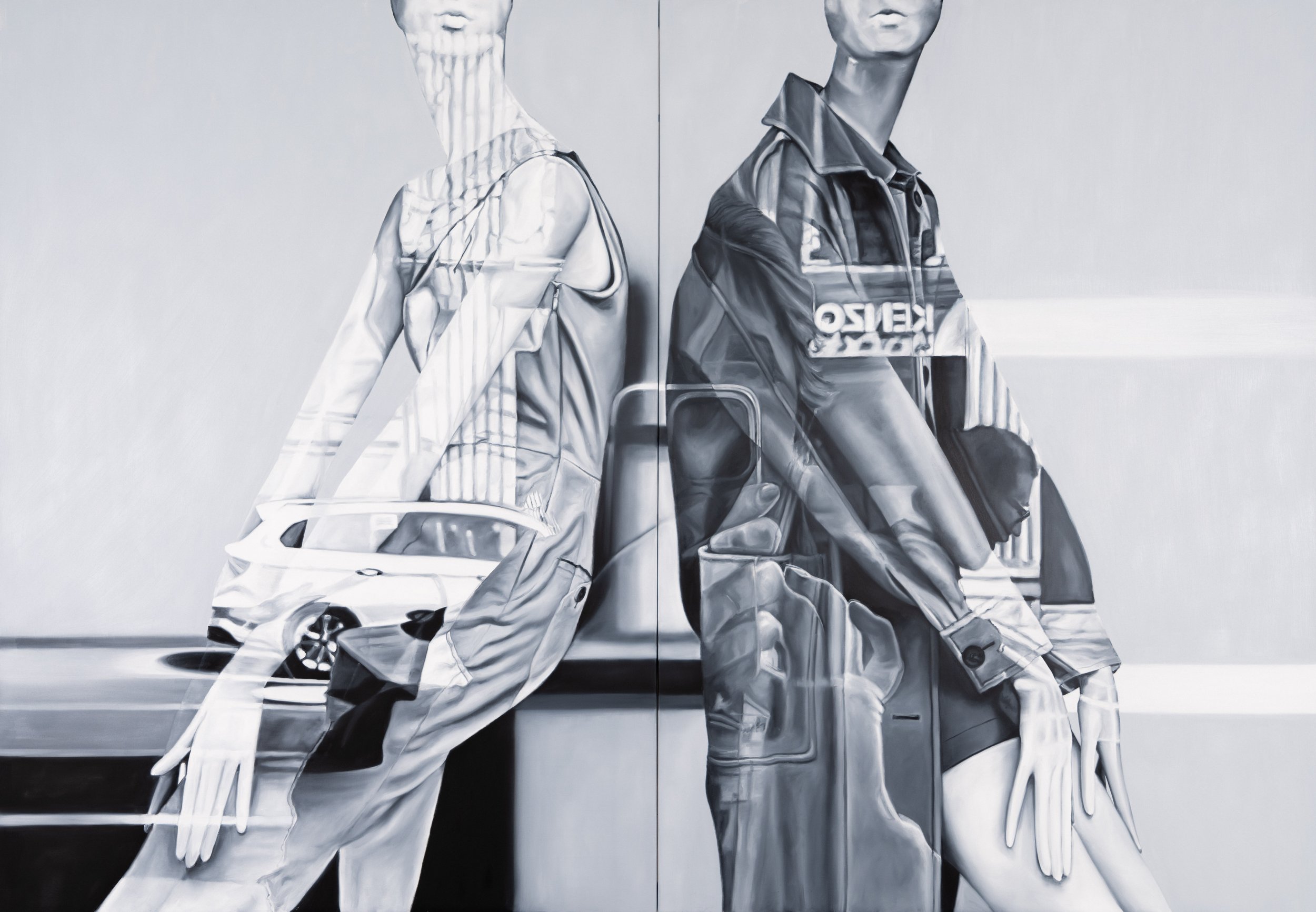
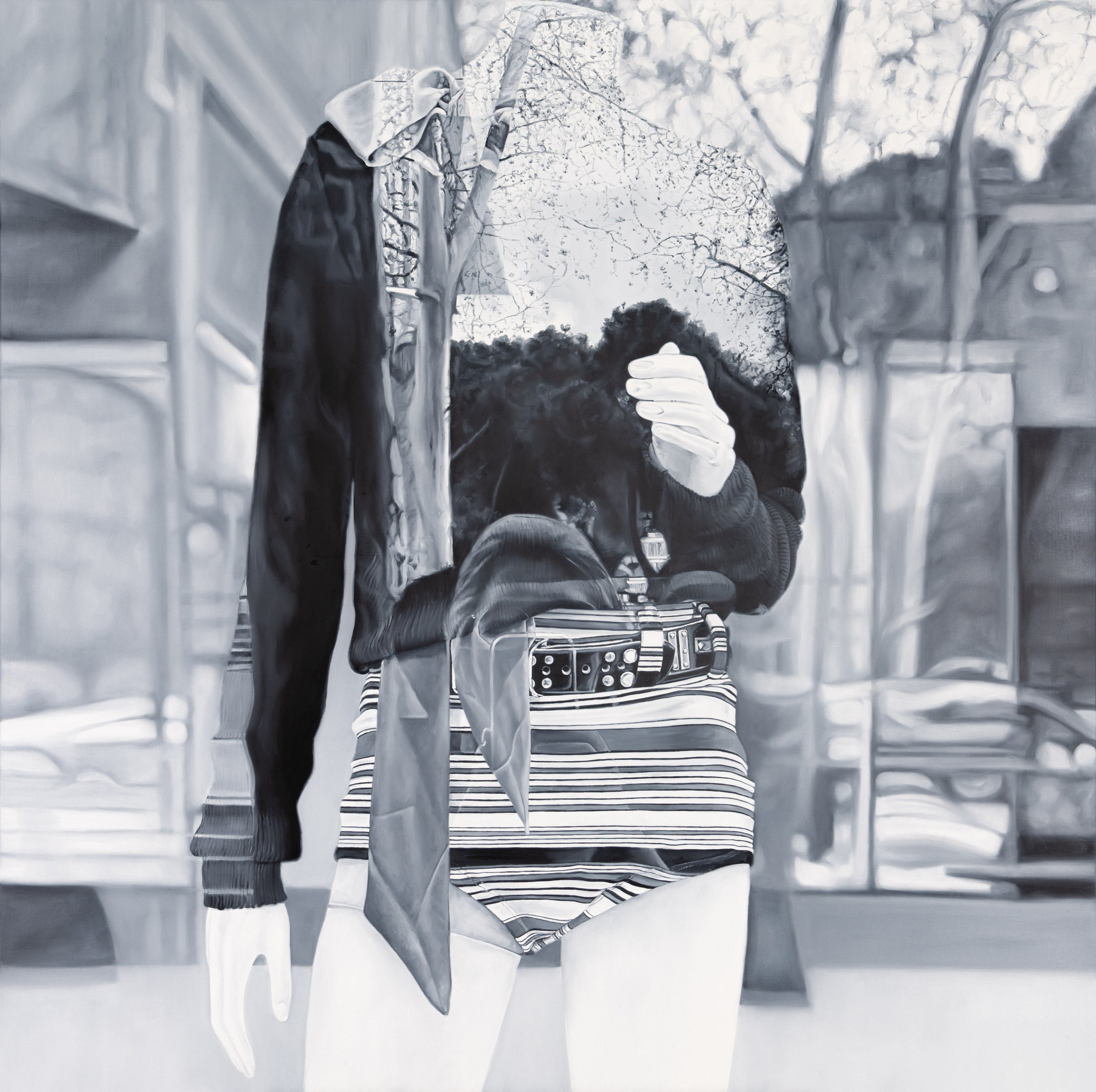
None of this mythical imagery appears in Marta’s canvases. What matters in her mannequins is not the appearance of animated and almost alive beauty. On the contrary, what counts is the surface of the present season’s clothing—or rather: the various surfaces that evolve around the prestige of fashion—the elegant, translucent casings of store windows that both attract and repel our gaze. It is the clothes, objects, and accessories that change at a rapid pace—the entire spectacle of fashion’s ephemerality that lends the mannequins their glamour...
Even so, it is not merely the demystification of the essence of glamour that is at stake in Marta’s canvases. This path was already trodden by Andy Warhol, who, by multiplying an iconic photograph of Marilyn Monroe, placed this emblem of glamorous beauty on the same level as his Brillo Boxes: soulless commodities that technological reproduction and advertising transform into stimuli that trigger the consumer’s conditioned reflexes.
In Marta’s paintings, the interplay of gazes captured by the merchandise is more subtle and complex. She expands it beyond the dimension of the object of desire, capturing the broader web of appearances—the facades of storefronts and closed showcases that still play a role in the world of haute couture, where store decor and design are just as important as—or even more important than—the clothes themselves. The glass panes of the storefronts, in turn, reflect fragments of the elegant urban landscape of European metropoles and offer glimpses of the logos of prestigious brands. It is in these translucent glass panes that the potential consumer’s gaze of desire suddenly appears: almost imperceptible, a few faint lines of it emerge—as if it were the apparition of a ghost—in the center of the canvas; there, the consumer, caught in the spiderwebs of “fashion,” comes face to face with her own gaze of desire—sister and friend to the mannequin manipulated by the world of consumerism.
This is not the first time the mannequin has appeared in art—far from it. The Surrealists and Dadaists had already been flirting with the thrill that the universe of objects, artifacts, and artifices provokes in our minds. For up until the industrial era, the world of myths and legends ignored the dividing line between the artisan and the artist; the difference that separates the artist from engineers, architects, and magicians was not as clear-cut as it is today. Only when industrialized technology took on the task of producing a literally infinite number of artifacts did the artist begin to separate himself from the artisan.
This contrast becomes apparent when we compare Marta’s paintings with the way De Chirico approached the mannequin motif in the last century, in 1914. He turned to wooden figures at the suggestion of his brother, Savinio, whose sketches of fashion mannequins with ovoid heads would be incorporated into paintings that breathe life into these static objects: the artist projects fantasies, thoughts, and ideas onto them and treats these figures as doubles of himself. At times he sees the mannequin as his brother, at times as the poets Sophocles and Euripides, and at times as the figure of the archaeologist. All of them are representations of the artist’s own contemplative life, whose work consists less in making and producing than in seeing and making others see, in opening himself up to another state of mind and guiding the viewer’s soul toward other ways of being in the world. The emphasis on this reflective and philosophical dimension is evident in the exaggerated proportions of the heads and torsos of the armless, legged mannequins, for example, in the paintings *Day and Night* or *The Mysterious Archaeologists*.
Marta Penter’s artistic reflection takes this further; she shifts it toward the dispersion of the gaze in the following century: in her canvases, the mannequins (always with proportions conforming to the ideal of slender, elongated beauty) disappear behind the seasonal outfits and fashions that clothe them; detached from the world of poetry and philosophy, they belong to the universe of consumerism and social media—the reflection of the potential consumer appears armed with the inevitable cell phone.
This world of sensational and ever-changing images and reflections is averse to the lingering gaze of contemplation; overloaded with visual stimuli, it traps our attention in a constant slide, and the rapid pace of these stimuli leaves no time for deep poetic contemplation or philosophical meditation – until the moment an artist holds our gaze captive within a fascinating web of strangeness that reopens the space for reflection and contemplation. Only then do we perceive the multiple layers of perception in which we normally plunge and nearly drown.
Marta has added to the large-format canvases a series of preliminary photographs that serve as the basis for the paintings, as well as a series of drawings featuring cut-out applications of dried paint: drawings of human figures with collages of accessories such as scarves, ties, and collars. Quite different from the main body of work, these drawings have something of the appeal of the old-fashioned children’s cut-out booklets, which offered the fun of cutting out colorful clothes and accessories to dress up cardboard mannequins.
With the enigmatic strangeness of this collection of canvases, photographs, and drawings, Marta plunges us into the most diverse worlds of desire—a desire that flows from one phantasmagoria to the next and draws us in (through various media and technological devices) into an immense world of visions that our minds and souls can barely absorb — until the moment when art opens its dome of stillness, that rare and precious space that invites us to pause, contemplate, and reflect.